Showing posts with label birds. Show all posts

Windpower and Wildlife

WIND art

LATELY MORE AND MORE homeowners are thinking about installing small turbines to generate power primarily for their own homes.

The advantages of wind power are obvious. The disadvantages are mostly a concern for people living near the turbines, who may complain about noise, vibration, or changed views. But for me the overriding worry is the potential effect on wildlife. It hardly makes sense to attract wildlife into your garden, then batter them with windmill blades, now does it?

FIRST, SOME BACKGROUND

Most of the concern about wildlife and windpower comes from research done on big, big turbines. Thus far there is plenty of evidence that collisions with the blades do kill birds and bats. There are also concerns about the effect of wind turbines on wildlife habitat. The area around the turbines, as well as the area under transmission lines, is usually cleared of vegetation. Also, some wild animals simply avoid areas where there are man-made structures. But research on the relationship between wildlife and big wind is only just beginning.

Wind proponents argue that the design of wind turbines has been improved to a point where the impact on birds is small. My reading suggests that we need more research to be sure of this.

It looks as though there is even more reason to worry about bats. Apparently nobody thought much about the effect of windpower on these animals until fairly recently. Now it turns out that bats may actually be attracted to wind turbines or to the areas around wind turbines. (Nobody knows why, though there is a lot of speculation.) They are very slow to reproduce, so the death of breeding-age animals could have a signficant impact on their populations. Research on this topic is even scantier than research on wildlife-impacts as a whole.

Researchers are continuing to try to improve the design of big wind turbines so that they’ll have less impact on wildlife, as well as on how to place them so that they’ll have less of an effect. The Nature Conservancy, an organization I respect, seems to be in favor of wind energy as long as turbines are sited properly. But personally I’m going to have trouble supporting big wind until more has been done to prevent injury to wildlife.

THINKING ABOUT ADDING A Small WIND TURBINE?

So what about small wind? First keep in mind that typical “small wind” isn’t all that small. Though you can buy tiny turbines that install on the roof of a house, when people talk about residential or small wind installations they are usually talking about a fairly large turbine (they look big to me, anyway) that installs on a tower somewhere near your home.

There are a lot of nonwildlife issues to consider before putting in one of these turbines, the upfront cost being just one. If you haven’t already done everything possible to make your home energy efficient, installing a smaller turbine is almost certainly not the best use of your money. If you are already energy efficient, CanWea’s Small Wind Energy site is a good place to look for resources that would help you explore this complicated decision.

What about wildlife? According to the CanWEA site, “migrating birds tend to fly well above small wind turbine height,” so at least one wildlife population is probably safe from a smaller turbine. But backyard birds and bats do appear to be at risk. In fact, CanWEA recommends against placing a smaller turbine “in areas where birds concentrate,” which would appear to rule out a home surrounded by wildlife-friendly landscaping … unless you happen to be an exceptionally bad gardener!

The CanWEA site argues that wind turbines “are far less of a danger to birds than buildings or household cats.” This is currently true, but it’s hardly an excuse for adding to the hazards our local wildlife already face. Besides, if homeowners continue to add turbines to their properties, the kill rates will increase.

HOW ABOUT ROOFTOP TURBINES?

Rooftop turbines are more interesting from a wildlife-impact point of view. Although they have moving blades that could potentially injure birds or bats, the hazard area is smaller because the turbines themselves are small. Also some of the designs look as though they would be much less hazardous to wildlife than the conventional vertical-blade (aka wildlife whacker) design. On the other hand, anything with moving blades might be hazardous. I wonder whether it would be possible to enclose a rooftop turbine in a cage?

The tiny turbines are controversial, however, and not just for the usual reasons (noise, etc.). Some critics contend that they do not work, or at least do not work well. The Wind Turbines Now website seems to provide a fairly balanced overview of the issues surrounding rooftop turbines.

I would like to see more research done on rooftop turbines before investing money in them. In June 2009 it was announced that the Boston Museum of Science had set up a Wind Turbine Lab for precisely that purpose, and it will be interesting to see what they (or other researchers) turn up.

WINDING UP

IMHO, wind turbines will not not a good choice for wildlife-friendly gardeners until someone can come up with a design that's been shown to be wildlife-safe. It’s hard enough protecting your birds and other wildlife from window strikes and neighborhood cats. We don’t need any more hazards in the backyard.

In the meantime, I’m going to be taking a closer look at solar power. The technology keeps improving. You can use solar to heat water and air directly, but if you would like to try using it to generate electricity, you'll be glad to know that the price of solar panels has dropped dramatically. Solar panels are quiet and inconspicuous, and above all ... they don't move.

Additional sources used in writing this post

“Assessing Impacts of Wind-Energy Development on Nocturnally Active Birds and Bats: A Guidance Document.” (pdf) Journal of Wildlife Management 71(8) 2007.

“Mitigation Toolbox.” Compiled by National Wind Coordinating Collaborative Mitigation Subgroup and Jennie Rectenwald.

“Wind Energy and Wildlife Concerns 101” (PowerPoint presentation). Dale Strickland. Presented at the Wind Wildlife Research Meeting VII, October 28, 2008, Milwaukee, WI.

“Wind & Wildlife: Key Research Topics.” Prepared by the National Wind Coordinating Collaborative Wildlife Workgroup. May 2008.

“Wind and Wildlife: Let’s Keep it Green” (PowerPoint presentation). The Nature Conservancy. Presented at the Wind Wildlife Research Meeting VII, October 28, 2008, Milwaukee, WI.

Credit

The art at the top of this post is from Dover Books’ Vintage Label Art, modified by me to add the “D” to “Win.”

Birds and Windows

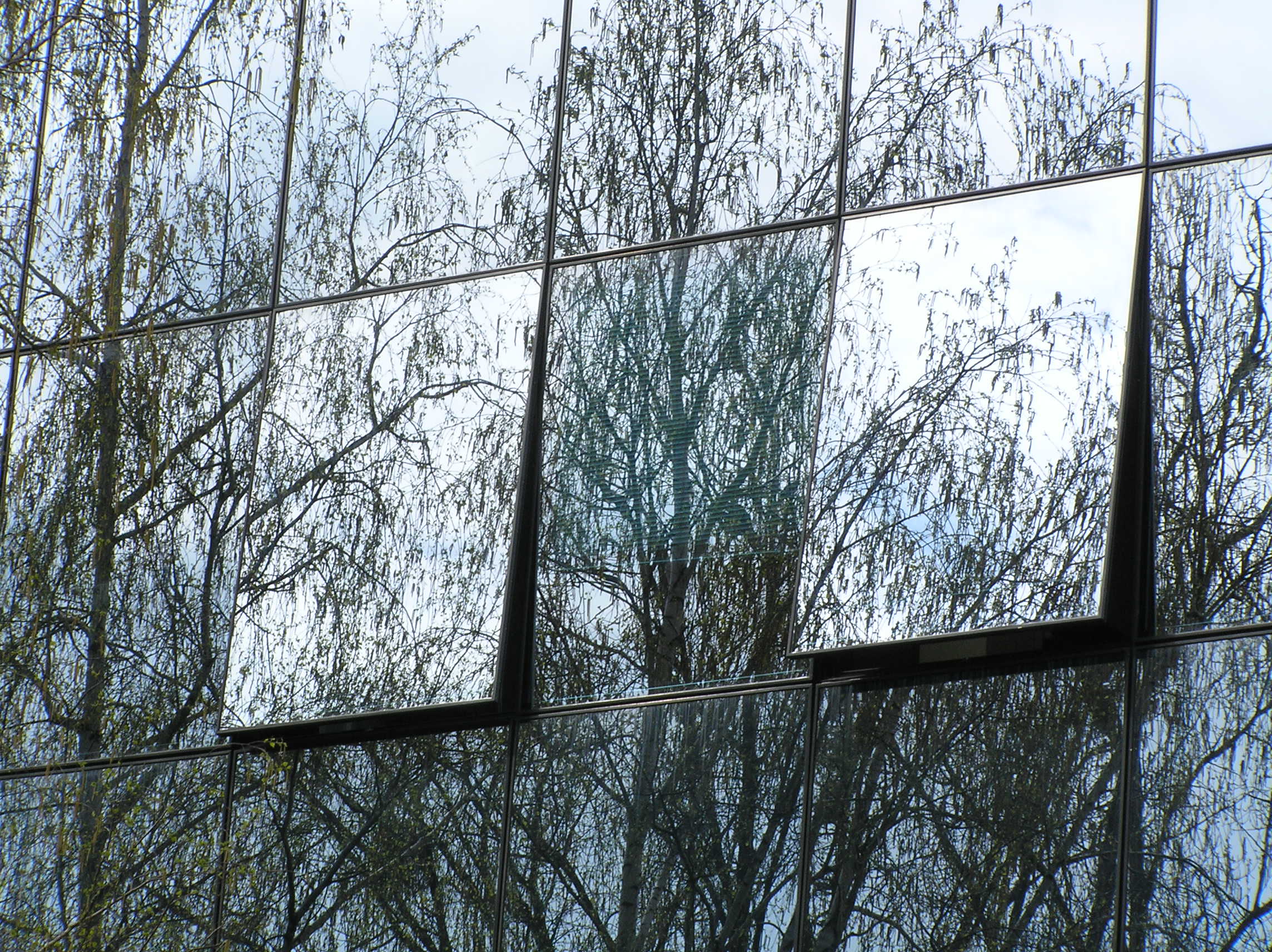
On sunny days, glass can be so highly reflective that humans as well as birds are fooled into thinking that they are looking at open sky, trees, or other scenes in nature. This is a serious hazard for birds, which are often injured or killed in collisions with window glass. Photo by MIROSLAV VAJDIC for openphoto.net CC:Attribution-ShareAlike

WITH SPRING WE OFTEN GET LOTS OF BRIGHT, SUNNY DAYS--good for gardeners, but not always so good for birds, who may crash into windows that are reflecting what look to them like beautiful open skies. If you have this problem, here are a few tips to help you and the birds do better this year.

Why they do it

Typically birds fly into windows for one of two reasons: 1., the window is reflecting sky or trees or some other scene the bird thinks it can fly into or, 2., the bird sees real daylight through a window and thinks it can fly through to the other side.

No fly-throughs

Situation number 2 is fairly easy to prevent. The trick is to avoid having uncurtained windows either directly opposite one another or kitty corner from one another. So for instance, if you have a large open living area with windows that face each other on the north and south sides of the house, make sure that the windows on one side are always covered with curtains. That way a bird will never get the idea that it can fly through your living area and come out safely on the other side.

Situation number 1 is more difficult. There are only two ways to deal with this situation. One is to put up a barrier that prevents birds from hitting windows. The other is to make your windows reflect less light.

Upon reflection ...

Let's look first at ways to make windows less reflective.

The easiest way to make your windows reflect less (and definitely the one that appeals to me) is just to let them get dirty. The dirtier the windows get, the fewer bird strikes you'll have.

Don't want to wait several years for your windows to get seriously murky? You can soap the outsides. Yes, people do this.

If you want clean windows, however, preventing bird strikes gets harder. But here are some ideas. I can't guarantee that any of these will work every time, but they probably will help to prevent at least some window strikes.

Idea number one: Glue small stick-on decals or use window clings (which are a lot easier to remove) all over the outside of the window, placing them about 8 inches apart. Yes, they have to be on the outside because putting them on the inside won't prevent the window glass from reflecting light. And yes, they do have to be that close together because if they're not, birds may try to fly between them. The window clings sold under the brand name of Whispering Windows are bird-themed and quite attractive.

Don't want pictures on your windows? Idea number two: Some people try hanging strips of shiny tape, often referred to as bird-scare tape, in front of windows. In theory the fluttering tape frightens birds so that they stay away from areas where it is hanging. (This trick is also used to scare birds away from orchards.) The Wisconsin Humane Society even sells a holographic bird-scare tape.

Idea number 3: For those who want a more conservative look, there is now a product called CollidEscape. It is a film that can be applied on the outside of window glass. I haven't tried it myself, but supposedly it makes the window glass much less reflective. From the outside (in the pictures anyway), it looks like a very tidy-looking version of soap. However, unlike soap it allows you to continue to see out the window, or so the manufacturer claims. Warning: This stuff is expensive: $3/square foot if you are referred through the Fatal Light Awareness Program, a worthwhile organization that is working to preserve the lives of migratory birds in urban areas.

Bird Barriers

Another technique is to put up a barrier that you can see through but that birds will bounce off of.

If you're a do-it-yourself type and your house lends itself to this modification, you may be able to install fine garden-protection netting from below your eves to below the windows. The netting will be almost invisible from inside the house or from the street, and if it is taut enough birds will bounce off it without being hurt--you are, in effect, making a bird trampoline. You might have to stretch the netting on a frame before installing it in order to get the desired effect. Please note that if the netting is not taut enough, birds might get tangled up in it. The netting also must be far enough away from the glass so that the birds bounce off the netting without striking the glass.

If you'd rather not do this yourself, the Bird Screen Company makes fiberglass window screens that can be attached to the outside of a window using hooks and suction cups. I haven't tried this product, but according to the manufacturer, the hooks hold the screen far enough away from the glass so that birds will bounce off unharmed. Though pricey, this product is quite a lot cheaper by the square foot than CollidEscape is.

And the winner is ...

Dirty windows! But that's at my house. If I were going to try anything other than good old-fashioned grime, I'd probably give the fiberglass Bird Screens a try. They seem to be practical and good looking, and I think there's a good chance they would stop most if not all window strikes. If you decide to try any of these techniques, please let me know how they work for you.

More Good News

Dear all,

Earlier today I wrote a sort of two-faced post in which on the one hand I said it was great that Douglas Tallamy's new book Bringing Nature Home: How Native Plants Sustain Wildlife in Our Gardens is getting a lot of publicity--but at the same time I gave a gigantic ho hum to the arrival of the book itself. I received a good comment from blogger Benjamin Vogt, who is relatively new to this style of gardening and liked the book a lot. He suggested that I haven't given the book enough credit and referred me to the review he wrote for his blog, The Deep Middle.

Having read Benjamin's summary and a list of fun facts he pulled from the book, I have to say that it sounds as though Tallamy's book is one of the better ones that have come out on this topic in the last decade. If you are new to native-plant gardening and looking for a book to get you started, see what you think after reading Benjamin's review and the other links provided in my original post, which is below. If you're not already familiar with the material, this book will probably kick start your enthusiasm for native plants and give you a new appreciation for the value of insects in the garden.

Cheers,

Wild Flora

Good news from the New York Times

The Victorian-era illustration above is from the Full Color Decorative Bird Illustrations CD-Rom and Book. This example was kindly provided by the publisher, Dover Publications.

HAVING WORKED AT THIS FOR SO LONG, I'm always a little amazed, and a lot thrilled, when mainstream publications start to promote ideas I've been talking about for at least a decade. So you can imagine how pleased I was when the New York Times "Home and Garden" section recently published an article titled, "To Feed the Birds, First Feed the Bugs."

Yes!

For the article, writer Ann Ravner visited the home of Doug Tallamy, author of a new book that has been gaining a lot of attention for naturalistic gardening: Bringing Nature Home was published by Timber Press last November. Tallamy is an entomologist at the University of Delaware. You can see his academic resume (and a nice photo) at the university's website. His book has its own website, which includes a couple of items that appear to be excerpts from the book:
  • "Gardening for Life" makes the argument for why it is so important for us to use native plants in our gardens and otherwise try to make these spaces wildlife and environmentally friendly.

  • "Gardening for Biodiversity" is a list of what Tallamy considers to be "the 20 best native woody and perennial plant genera for supporting biodiversity in East Coast suburban landscapes."

The latter illustrates why books such as these are often a disappointment to anyone who is beyond the beginner level of native-plant gardening. Because books such as Tallamy's have to appeal to a wide audience, they are often too general to be of much help once you are actually trying to create a native plant garden in a specific region. For instance, Tallamy lists all the usual suspects of the native plant world. And because he lists genera rather than species, you will still have to find out which plants are appropriate for your region.

To be honest, I'm not all that interested in Tallamy's book (which I hasten to admit I have not read--so if I'm wrong about it, please tell me). I'm very glad he wrote it, but my initial investigation suggests that it's another in a growing list of books that cover more or less the same ground. Probably the first of them, or at least the first to get a lot of attention, was Sarah Stein's Noah's Garden: Restoring the Ecology of Our Own Back Yards, which was published in 1995. In the late 1990s, I bought a lot of these books. But eventually I tired of reading the same information over and over again. Now I spend my money on reference works that are specific to my region.

That isn't to say that these books should not be published! On the contrary, every time one of them comes out there is a chance it will catch a wave of publicity, as Tallamy's has. Each wave of publicity attracts new people to native-plant gardening. Many people who are avid native-plant gardeners today caught the bug by reading Stein. Ten years from now, it looks like we'll have another batch who were inspired by Tallamy's work.

Witness the article in the New York Times, which allows us to pay a vicarious visit to Tallamy's garden in Pennsylvania, where he and his wife have removed non-native, invasive plants such as Oriental bittersweet, Japanese honeysuckle, and multiflora rose, and replaced them with natives such as white pine, black cherry, and goldenrod. The best part of the article is Tallamy's argument in favor of encouraging insects in the garden. He is quoted as saying that 96% of North American birds other than seabirds feed their young on insects.

None of this is exactly new, but it probably is new to a lot of New York Times readers. So let's celebrate. With its lovely pictures of native plants and the insects that depend on them, the New York Times article is a great advertisement for native plant gardening.

Meanwhile, if you'd like to learn more about Tallamy's book, I recommend the following:

(Not So) Scary Things About Peanut Butter

Photograph by Piccolo Namek, made available via Wikimedia Commons under a GNU Free Documentation License.

Back in December, I wrote about using peanut butter, straight from the jar, as a winter food for birds. Someone then asked about the possibility that sugar or preservatives in commercial peanut butter might be harmful to birds. I decided to do some investigating, and this is what I learned:

As far as I have been able to find out without checking the ingredients of every brand, commercial peanut butters contain salt, sometimes sugar, and what are known as stabilizers, which prevent the oil and solids from separating.

You can leave it on the shelf (for a while anyway)

Preservatives are not generally found in peanut butter because peanut butter has such a low moisture content that it does not support the growth of bacteria—at least, that’s what is claimed by leading peanutbutterologists.

That’s why people are able to keep opened peanut butter on the shelf rather than refrigerate it. However, the oils in peanut butter can go rancid, especially in heat. That jar on your shelf will eventually start to smell off if you leave it long enough, and should be thrown out at that point.

A fungus among us?

Peanuts, hence peanut butter, are also susceptible to an Aspergillus mold (A. flavus, to be exact) that produces the potential liver carcinogen called aflatoxin. Both commercial and “natural” peanut butters are equally subject to this problem as Aspergillus occurs naturally on peanuts as well as on a number of other food products. Amounts of aflatoxin in human food are closely regulated in North America, and most authorities seem to agree that risk from aflatoxin in foods in the industrial world is vanishingly low.

That being said, the risk of aflatoxin contamination is apparently lowest when the peanuts are ground soon after picking and immediately placed in an airtight container. As a result, this may be one of those cases (and they do occur) where buying the big supermarket brand is a safe choice. About 5-10 years ago when the Consumers Union in the United States tested various brands of peanut butter for their aflatoxin content, the highest levels were found in peanut butter “ground fresh” in health food stores, whereas the lowest levels were found in the big supermarket brands.

Trans-fat free?

Another possible reason to be afraid of peanut butter is the stabilizers used to keep peanut butter from separating. Generally these are fats of some type; they used to use hydrogenated vegetable oils but these are being phased out. I don’t have information on what’s being used to replace them. However, in the United States at least (and I suspect in Canada as well), peanut butter must be at least 90% peanuts. The quantity of stabilizers of any type to be found in peanut butter is relatively small.

Our friend, the peanut

Peanuts themselves convey quite a few health benefits, incidentally. According to the Wikipedia, they contain high levels of monounsaturated fats and Resveratrol (a phytoalexin also found in the skin of red grapes), various nutrients, and an antioxidant called p-coumaric acid. The American Peanut Council is even touting a study in which peanuts were found to be so nutritional and satiating that they might be used as a method of weight control.

But that's a possible benefit to me, not a bird. When all is said and done, I've concluded that peanut butter is not very scary at all. I certainly have not been able to find any evidence that birds are placed in any danger by consuming the relatively small amounts of sugar, stabilizers, or salt found in commercial peanut butter.
This item originated as a posting to the NSNature e-list.

Where do little birds sleep in winter?

MANY BIRDS DEPART FOR WARMER CLIMATES when winter comes. But the presence of chickadees, finches, and other small birds at winter feeders attests to the fact that quite a few species stick around all winter long. On warmer winter days these birds' layers of feathers and down keep them quite warm, especially when friendly humans help to make sure they are able to meet their calorie needs. But where do they go at night and in harsh weather?

The importance of evergreens

In harsh weather birds seek shelter just as we do. Dense evergreens are often used for this purpose, which is one of many reasons why it's good to include evergreens in your wildlife-friendly garden. Evergreens that are left to grow naturally--not pruned or limbed up--typically provide better shelter. An evergreen that has been very heavily pruned (for example, to form a hedge) may be so dense that birds can't get into it, making it useless as shelter.

The importance of dead trees

Quite a few species of birds hide from storms in holes in dead or dying trees. Chickadees prefer to nest alone in a cavity just large enough to shelter a single bird. But some species, such as finches, will roost in the same cavity in order to share body heat.

Sadly, dead and dying trees are increasingly difficult to find. You may be able to provide an alternative, however, by putting up what's known as a roost box. This is similar to a nest box in that both are attempts to duplicate a cavity in a dead or dying tree. A roost box is designed for winter use, however, whereas a nest box is designed for use in warmer weather.

How a roost box is different from a nest box

As shown in the diagram above, a roost box is designed to hold in heat: There are no ventilation holes in the top of the box, and the entry is down toward the bottom. Typically the box has perches on the inside, allowing one or more birds to sit comfortably.

In contrast, the nest box does have ventilation holes under the roof. There are no perches in the box because the bird doesn't use it for perching: She builds a nest for her eggs down in the bottom of the box. Placing the entry at the top of the box helps to protect the eggs and baby birds from predators. Often the inside front of the box is roughened or ridged to help the young birds climb out of the box when it's time to leave.

How roost boxes are similar to nest boxes

Neither a roost box nor a nest box should have a perch on the outside. The birds don't need one, and putting a perch on the outside of the box just gives predators something to stand on. Both should have drainage holes in the bottom. Both should have a door that can be opened for cleaning. The exact dimensions of the box will vary depending on the species you're trying to attract; the entry hole should be as small as possible in order to deter predators.

I've found that birds generally won't use nest boxes or roost boxes if there are natural cavities available in the area. (This is a very good reason to protect those dead and dying trees!) However, these are good additions to your property if you live in an area where all the old, dying trees have been cut down.

How to make your own

If you're handy with wood, making roost boxes and nest boxes is an enjoyable project; the boxes are decorative, and there is always at least some chance the birds will use them. Plans for roost boxes are readily available online. Here are a few sites:

More on Deer

THE BOOTSTRAP ANALYSIS BLOG has an interesting report on deer browing and songbirds. "Nuthatch," the anonymous academic who writes the blog, reviews an article in a recent issue of Ibis, the journal of the British Ornithologists' Union. The article discusses the way in which browsing by deer changes ecosystems and reduces their value for songbirds. This is a concern for wildlife-friendly gardeners because, as I mentioned in a previous post, typical suburban landscaping tends to create deer habitat and thus encourage deer overpopulation. (And then gardeners complain that they have too many deer.)

In testimony to this phenomenon, Nuthatch also refers to an article that appeared earlier this month in the New York Times, which said that white-tailed deer populations have risen from 300,000-500,000 at the turn of the century (down from 20 million or more because of overhunting). According to the newspaper, there are now about 32 million white-tailed deer in the United States. Note that this is 12 million more deer than were present before the arrival of Europeans!

And of course the combination of exploding deer populations and the automobile is not a good one. A clever graphic that accompanies the article gives the annual odds of hitting a deer in the United States as anywhere from 1 in 57 to 1 in 245 in the less urban parts of the Northeast. (In other words, anywhere from 1 out of 57 drivers to 1 in 245 drivers will hit a deer during a 12-month period.) I don't know how this would translate into odds, but I know that on the short stretch of road in front of my house, at least one deer is hit and killed every year. That doesn't count the people who end up in a ditch because they swerved to avoid one.

The table of contents of the issue of Ibis is here.

Winter Bird Feeding


THERE WAS SNOW ON THE GROUND this morning, marking the time to begin my winter regime of bird feeding. In winter and spring, I make an effort to be more consistent about keeping the feeders full, for reasons explained recently in this post. Other than that, the one big addition to my usual routine is a giant jar of the cheapest peanut butter I can find.

Years ago, before meat came in packages from the grocery store, butchers often gave away bits of cow carcass that their human customers did not want to eat. This is how many dogs got their bones; these days, it is almost impossible to get a dog bone from from a butcher, even if you offer to pay for it.

The butcher was also a source for a winter bird food known as suet. Suet is a thick piece of nearly pure white fat that is found behind a cow or steer's kidneys. Hung outside, often in an old onion bag, it would provide high-calorie fuel for small birds during the depths of winter. Suet functions as a substitute for insects, which are also quite high in fat, during a time of year when insects are very difficult to find.

Today it is almost as difficult to get suet from a butcher as it is to get a good dog bone. However, you can purchase suet in stores; it usually comes in the form of a square cake that fits into a "suet holder" that you can also purchase.

I spent a lot of money on commercially prepared suet over the years, believing that this was the ideal way to feed winter birds. But eventually I realized that the custom of feeding suet arose because suet used to be cheap, not because suet is necessarily the ideal food. As a matter of fact, almost any high-fat food will work just as well. And birds actually seem to prefer peanut butter. When you buy it in the giant jars in the bulk foods section of the grocery store, peanut butter is also also quite a lot cheaper than commercial suet.

After discovering peanut butter, I went through several years in which I tried combining it with other things, such as corn meal or dried fruit. Eventually I realized that this is unnecessary and wasteful, so I just started putting out straight peanut butter.

Some people are afraid to give birds straight peanut butter because they've heard that the birds will choke. But I've never seen or uncovered any evidence that this is likely to happen. As far as I know, most authorities now consider this to be an urban legend.

The only concern in offering birds peanut butter or any other high-fat food is that these foods should not be left outside in warm weather. Fats of all types go rancid in heat. This is why I reserve peanut butter for winter feeding.

All of which is to say that today I celebrated the beginning of winter by finding a couple of old, battered suet feeders, a large jar of inexpensive peanut butter that I bought a couple of weeks ago in expectation of this day, and a big spreading knife. I scooped peanut butter out of the jar and into the suet feeders. Within a minute after I had hung up the first one, a chickadee had taken its first bite.

If you don't have some old suet feeders in the garden shed, you can make a peanut butter feeder out of almost anything: a can open at both ends, a piece of scrap lumber as long as it's not treated. Peanut butter sticks to almost anything, after all. Screw an eye-hook into whatever it is, hang it up where the birds will see it, and you have a free feeder. Do not spread peanut butter on a live tree or shrub, however; squirrels will chew through the bark as they try to get at the last of the peanut butter.

In addition to offering peanut butter to the birds, I will also continue to offer the same foods I put out during the rest of the year: black oil sunflower seeds in the hanging feeders and, thrown daily onto the driveway, cracked corn and/or white millet and/or the cheapest seed mix I can find, which is likely to be mostly white millet. (More about choosing seeds for birds can be found in this post.) This combination keeps a wide array of birds (chickadees, nuthatches, doves, juncos, various sparrows, and various finches, to name a few) very happy during the winter. The peanut butter may even attract woodpeckers and other birds that ordinarily would eat mostly insects.

Do You Have to Feed Birds All Winter?

IT'S WIDELY BELIEVED THAT anyone who puts up a bird feeder, especially in winter, is duty-bound to keep the feeder full day in and day out. This notion is based on the belief, also widely held, that birds become "dependent" on feeders, thus will starve if we humans don't keep the feeders full.

As is so often the case, the reality is more complicated than that. Research into the habits of birds that visit bird feeders indicates that they use the seed we supply primarily as a supplement to other food sources. They probably rely more heavily on this supplemental food in winter and spring, because calorie needs are high in those seasons. (In winter, they need the extra calories to stay warm; in spring, because they are nesting and raising babies.) However, birds forage widely for food, so if the feeder in one garden happens to be empty they usually know of other places where they can get something to eat.

Think about it: Nature never provides a constant supply of food from any one source. Seeds of one patch of plants mature and are available for eating for a week or so, get eaten, and disappear. The birds move on to another food source. (This is one of many reasons why it's important to have diversity in plantings.) The bird that became dependent on one particular type of seed from one particular patch of plants wouldn't survive its first week!

Birds as a group do not become dependent on feeders in the sense that they cannot survive without them. Mom Nature is not that dumb.

But does that mean you can go to Florida for a week in January and not worry about keeping the feeder full? Well, it depends.

How birds use feeders depends on the species. Banding studies show that members of the finch family tend to move around a lot; the finch you see at your feeder today is probably not the same finch you saw yesterday, even if they do look alike. These birds deal with food shortages simply by moving on to the next food source, be it a patch of plants or somebody else's feeder. In contrast, chickadees tend to be faithful to a particular territory, especially in winter. Throughout the winter the same small flock (usually about six birds) will visit your feeder all day every day as long as you keep it full. But even chickadees are prepared to deal with shortages; a lot of the seeds they take from your feeders are not eaten that day--instead, the seeds are hidden for future use. An individual bird can remember thousands--yes, thousands--of spots where it has hidden seeds away.

This means that the majority of birds will survive even if you leave the feeders empty for a week during a cold snap. There's no evidence that a population of birds has ever been wiped out because somebody forgot to fill her bird feeders.

Individual birds are another matter, however. The presence of a well-stocked bird feeder can make the difference between life and death for a bird that would have died without human intervention.

Sick or injured birds are an example. These birds will often hang around feeders because they are not able to feed themselves as easily as other birds are. Sick birds usually die regardless of whether they have access to food, and their presence at feeders may be a threat to healthy birds. Injured birds may heal, however; many people have heart-warming stories of one-legged or otherwise disabled birds that have managed to live, sometimes for years, through the kindness of humans. These are birds that Mom Nature, who is smart but not always kind, would have thrown out of the gene pool. They survive only because some humans have an endearing soft spot for weak and vulnerable creatures.

Another example is what happens during a patch of especially harsh weather. Mom Nature would let some of the weaker birds freeze or starve. Not so we soft-hearted humans; when we make food readily available, even in the worst weather, we help the marginal creatures get by.

So ... do you need to keep those feeders full or not? The less-than-simple answer is that it depends on how hard hearted you are. Some people would, and do, argue that providing supplemental food interferes with Nature's plan, helping weaker animals to survive and breed when it would be better to let them die. This is harsh, but it may be true.

Efforts to keep individual birds alive are often destined for failure. Nature has plenty of ways to prevent a species from overpopulating. If starvation doesn't bring the population down, disease (a very real danger among feeder birds, who pass diseases around while sharing space at the feeder) may do the trick. And if not disease, hungry predators (like that hawk who will probably be attracted to your feeder at one time or another) will take care of the problem.

On the other hand, some of us get emotionally attached to "our" birds. And we think it's worth making the effort to feed them, even if it only gives a few individuals a few more days or weeks (but possibly months or even years) of life. Humans are just funny that way.

If you're in this camp, you'll want to try to keep your feeders full. However, if you do happen to miss a day or even a few days, you can rest easy in the knowledge that the vast majority of your feathered friends will make it through just fine.

How to Set Up Those Bird Feeders

Above: One of many bird feeders I had around my house in the Pacific Northwest. Note that it was positioned close to a living room window, so I could watch the birds. Though designed as a squirrel baffle, the plastic dome over the feeder helped to keep the seed dry. Unfortunately, this style of feeder doesn't take a plastic dish to catch seed, so I had to clean the ground under the feeder using a small rake. The feeder was positioned away from the bird bath (it looks like a large rock) so that seed and droppings don't fall in the water.

MOST BIRDS ARE MESSY EATERS. They throw seed around. They scatter seed hulls, to say nothing of droppings. If you let this stuff accumulate under the feeder it will not only make a mess but also, potentially, spread disease to other birds.
That's why it's important to give some thought to how you set up a bird feeder. Your goal is to make cleanup as easy as possible.

One trick is to attach a plastic tray to the bottom of your feeder. The tray will catch most, but probably not all, droppings and waste, and it can be removed for easy cleaning. Droll Yankees makes trays that attach to the bottoms of almost all of their feeders. It's also possible to buy trays that can be hung underneath other styles of feeders. In choosing a tray, bigger is better because bigger trays catch more. You also should think about how easy the tray will be to clean, as it will have to be cleaned often.

A disadvantage of trays is that they provide comfortable seating for squirrels and large birds. If you're trying to avoid feeding either or both of the former, you may want to try another option.

An alternative to putting a tray under your feeder is to hang the feeder over a surface that can be swept easily. This is also a good way to feed ground-feeding birds: If you throw the seed on a driveway, for example, it will be easier for you to sweep up or hose off any waste.

You can also put a big piece of cardboard under your feeder, as long as you replace the cardboard often. (That wet cardboard covered in bird droppings will be a fine addition to your compost bin, incidentally.)

Another potential threat to birds is damp seed, which can quickly become moldy. It's important to store seed in a dry place and not buy so much at one time that it will go moldy before you use it. Likewise, don't put more seed in the feeders than can be used up in a day or so.

Although a good-quality feeder will be relatively watertight, it's unlikely that any feeder will be completely waterproof. So it's a good idea to put your feeder where it will stay as dry as possible. Possibly the best possible location for a feeder is underneath your eaves, especially if they are wide, or on a roofed-in porch. If you put the feeder near a window, you will not only keep the feeder dry but also bring the birds where you can get a good look at them.

If you don't want to hang the feeder near the house, do put it under a cover of some sort. You can buy clear plastic domes for this purpose. Sometimes they're referred to as squirrel baffles, because they can also be used to prevent squirrels from reaching a feeder, but they also work well as rain covers.

What Type of Seed Should You Put in Those Feeders?


Above, black-oil sunflower seed, shown at the top of the photo, is the birdseed of choice for feeders that are above the ground. Cracked corn, shown at the bottom of the photo, is a good choice for birds such as doves, pheasants, and quail, and should be scattered on the ground.
For information on how to buy a bird feeder, click here.

DIFFERENT BIRDS HANG OUT IN DIFFERENT RESTAURANTS. In other words, different birds have different styles of eating and prefer different types of food. Some, like doves, sparrows, juncos, pheasants, and quail, prefer to eat on the ground rather than from a feeder that's suspended above the ground. They also tend to enjoy cracked corn and millet.

On the other hand, birds such as chickadees, nuthatches, and finches, like to visit feeders that are suspended above ground. Fortunately for those of us who prefer to keep our bird feeding activities as simple as possible, all of these birds seem to enjoy black-oil sunflower seed. In fact, studies show that black-oil sunflower seed is the favorite food of chickadees and nuthatches, two species that are widespread and universally loved.

So the easiest and most cost-efficient way to fill feeders is to buy black-oil sunflower seed in quantity, store it in a dry place (a metal garbage can works well if the seed is stored where rodents might get to it), and use it in all the feeders.

Why is black-oil sunflower seed so popular with these small birds? The seeds are small and have a thin shell, making them easy to eat. They are also very nutritious.

The seed is also a good choice for you, the person who is earning the money to buy the seed for these little guys. Black-oil sunflower seed keeps well, and it's inexpensive compared to some other seeds such as niger thistle (aka nyger). What's more, there don't seem to be any major environmental concerns around growing sunflowers for seed; in fact, sunflowers are North America's only native agricultural crop. Most of the crop is used to make oil for human use; the seeds that are designated for birds are those that are not of good enough quality to be used for oil.

Now, black-oil sunflower seed is more expensive by the pound than many birdseed mixes you might find in grocery stores, but in practice it probably is cheaper to use because there's less waste. When mixes are offered in feeders, birds tend to pick through the seeds, looking for the ones they like best. The seeds they don't care for are dropped on the ground, where they can make a mess or attract rodents.

Seed on the ground also attracts birds such as sparrows and juncos. But it's best not to encourage these birds to eat right underneath your feeders. (Think about it--it's not very hygienic!) All in all, the best strategy is to buy one type of seed for the feeders and, if you want to feed ground-feeding birds, buy them some seed of their own.

I usually buy black-oil sunflower in quantity for the feeders and keep it in a metal garbage can on the porch. For the ground-feeding birds, I buy both cracked corn and an inexpensive mix that is predominantly composed of millet (those round, shiny, off-white little seeds) but also has a bit of sunflower seed in it. This appeals to a wide variety of ground-feeding birds, including the pheasants we get around here. (When I lived on the West Coast, the same strategy attracted whole families of California quail.) Food for ground-feeding birds is scattered right on the driveway, away from the hanging feeders.

Coming soon: How to set up a bird feeding station.

Buying a Bird Feeder

Shown above is a metal bird feeder, made in England, designed to frustrate squirrels. The cage works well to keep out large (that is, adult Eastern gray) squirrels, but the holes are too large to frustrate young gray squirrels, red squirrels, or most large birds. Cover, our celebrity spokesduck, is a little too big, however.

AT ONE TIME, I HAD 17 BIRD FEEDERS. What can I say? Once I also had 10 cats. I used to believe in the principle that if something is worth doing, it's worth doing to excess.

Now that my watchword is moderation, however, at least I do know quite a bit about bird feeders (and cats). Fall is a time when people often start feeding birds (and with good reason, as studies show that access to well-stocked feeders does help birds survive the winter). So here is my advice on how to choose a bird feeder:

1. Get a bird feeder made of heavy-duty plastic and metal. Yes, I know, you love the rustic look of wood. So do I. But, in my reluctant opinion, wooden feeders are often not the most practical choice. First, they can easily be destroyed by squirrels, which can chew right through wood in search of birdseed. Second, in wet weather wood tends to get damp and stay damp. Dampness means mold, and moldy seed is not good for birds. Finally, wooden feeders are hard to clean. In contrast, a good-quality bird feeder made of heavy plastic and metal will resist squirrels, help to keep your seed dry, and be easy to clean.

Among my favorite feeders are the ones made by the well-known company called Droll Yankees. As far as I know they are easy to find all over North America. These tube-shaped feeders are made of high-impact plastic with metal at the top and bottom and around the holes from which the birds get the seeds. They come with a guarantee. They are relatively watertight. You can take them apart for cleaning and even put them through a dishwasher. And they are very reasonably priced, given the quality of the feeders.

2. Buy a feeder that will hold about a pound or two of seed. That amount doesn't have to be precise. The point is that you want to get a feeder big enough so that you don't have to refill it every day, but not so big that the seed will go moldy before the birds have a chance to eat it. For most people, that means a feeder holding a pound or two of seed, like the Droll Yankees' classic A-6 model, the first tube-shaped feeder ever introduced (in 1969) and still the one to beat.

3. Plan to feed squirrels. Most parts of North America today are abundantly supplied with the large, gray, fuzzy-tailed rodents most people think of when they hear the word squirrel. Actually, chances are that what you're seeing is just one type of squirrel--the Eastern gray squirrel, a species that is doing very well, perhaps too well, in many areas where it is not native. If you are lucky enough to have small red squirrels coming to your feeder, consider feeding them, as they are most likely native and may be threatened in your area.

Eastern gray squirrels, on the other hand, are far from threatened; some people even blame them for driving out the smaller red squirrels, although other people think they are being unfairly blamed for changes caused by humans. One thing is certain: Grey squirrels make a full-time job of emptying bird feeders. This infuriates some people, who then spend a lot of time and/or money fighting off the furry marauders. (Often unsuccessfully, I might add.) If you want to keep your bird feeding simple, plan on sharing. If you can't fight 'em ... feed 'em.

4. If you don't want to feed squirrels ... plan on spending extra money. There are good reasons to try not to feed grey squirrels, including the possible impact on native red squirrels, and there are a variety of devices designed to frustrate grey squirrels. But they do tend to be expensive.

Many anti-squirrel devices, called baffles, are designed to prevent squirrels from reaching a bird feeder. These include covers designed to prevent squirrels from reaching bird feeders from above and plates, cones, or drums designed to prevent squirrels from reaching bird feeders from the sides or from below. (Here are various such devices made by Duncraft.) In my experience, sooner or later squirrels usually manage to find a way to get around these devices. (Remember: They are clever, agile animals, and getting into your bird feeder is the only thing they have to do ... all day.)

I think squirrel-resistant feeders usually work better, although not perfectly. (Note that I said squirrel resistant, not squirrel proof.) One of the simpler and more economical versions is a bird feeder in a cage, shown above. The one shown work fairly well on adult grey squirrels, much less well on the young 'uns, who can slip through the bars. For more protection, look for a cage with smaller openings.

Another option is a feeder that is designed to close if a heavy animal such as a squirrel sits on it; these often can be set so that they will frustrate not only squirrels but also larger birds such as blue jays and doves. The best of these models are built like tanks (the better to frustrate the powerful jaws of professional rodents), and priced to match. After getting over sticker shock, I've had good luck with a feeder similar to the Heritage Farms Absolute II Squirrel Proof Feeder, for example.

But there are quite a few different styles, as you can see at the Duncraft website. And (no doubt this is a testimony to the inventiveness of squirrels) new styles are being introduced all the time. The "Yankee Flipper" from Droll Yankees is one such new entry, for example.

Coming soon: Where to put a feeder, and what to put in it.


Vanishing Birds


Photos: Top, populations of the rufous hummingbird have declined 58% since 1967, according to a new study just released by the Audubon Society. Left, populations of evening grosbeaks have declined 78%. Both photos courtesy the U.S. Fish and Wildlife Service, via the Wikipedia.

THE AUDUBON SOCIETY HAS JUST RELEASED an analysis of 40 years of reports on bird populations with the unhappy conclusion that many bird species are in decline: "Since 1967 the average population of the common birds in steepest decline has fallen by 68 percent; some individual species nose-dived as much as 80 percent. All 20 birds on the national Common Birds in Decline list lost at least half their populations in just four decades."

A surprising number of these species would be familiar to most gardeners. Among the popular "backyard birds" that made the list was one of my own favorites, the evening grosbeak. Populations of this large black and yellow bird, which has a distinctive bright yellow slash above its eye, are down an astonishing 78% since 1967. (The decline in this species is second only to the decline in populations of the northern bobwhite, down 82%.) If you live almost anywhere in the United States or southern Canada, you've probably hosted flocks of these birds at your feeders.

Another surprise is the decline in populations of the common grackle, a member of the Corvid (crow) family, that is often seen in urban areas and parks. Because it seems to get along well with humans, I wouldn't have expected this bird to be in decline--but it is, down 61%.

Populations of rufous hummingbirds, which are the hummingbirds most likely to be seen at feeders on the West Coast, are down 58%.

If you live in a rural area or area where there is still natural habitat left, you are likely to spot a lot more good friends on this list: The boreal chickadee (down 73%), eastern meadowlark (72%), field sparrow (68%), and ruffed grouse (54%) are just a few examples from the "top 20" list.

All of these declines can be attributed, one way or another, to loss of habitat. Farmland and meadow birds are suffering because of suburban sprawl, industrial development, and the replacement of old-fashioned farming methods with intensive agriculture. Other birds are in trouble because of climate change, deforestation, and loss of wetlands.

None of these species is on the verge of extinction, at least not yet. But such huge declines are very worrisome. What can we, as wildlife-friendly gardeners, do? Here are Audubon's recommendations, with my comments:
  • Protect local habitat. This would include gardening and landscaping in a wildlife-friendly way, as well protecting natural areas where they still exist in your neighborhood. You can also support organizations, such as the Nature Conservancy, that protect critical habitat areas.

  • Support sustainable forests. One good way to do this is to buy wood products certified by the Forest Stewardship Council, which is the toughest of the certification programs. The Audubon Society notes that this would be especially helpful to our friends the evening grosbeaks, as they are dependent on boreal forests as breeding grounds.

  • Promote sound agricultural policy. Agriculture has a tremendous impact on wildlife, and our shopping and eating choices have a tremendous impact on agriculture. Once you've made your own property wildlife friendly, it seems to me that the natural "next step" is to support farmers who manage their land in a wildlife-friendly way. You can do this by shopping for organic, locally grown, seasonal foods and getting to know your local food producers. Let them know that you care about wildlife-friendly farming practices.

  • Protect wetlands. If you have wet areas on your own land, large or small, value them, plant them with native plants, and protect them. They are essential not only for many birds but also for other animals, particularly amphibians.

  • Fight global warming. There are lots of ways to do this, but as gardeners we can avoid using tools that are powered by gasoline or electricity, plant trees, landscape in such a way that we reduce heating and cooling costs in the home, improve soil quality, grow our own vegetables ... and probably quite a few other things as well.

  • Combat invasive species. This recommendation is particularly relevant to gardeners, as sadly we have been responsible for the introduction of far too many species that have caused degradation of wildlife habitat. The easiest way to avoid planting invasive species and help wildlife at the same time is to garden with native plants.
Each of these recommendations would be helpful not just to birds but to all native wildlife, to say nothing of human health and quality of life! They deserve more discussion than I can give them in a single post. Where they're relevant to gardening and landscaping, I'll be coming back to them in future installments.


Meet the Natives: Solomon's Seal


IT'S ARCHITECTURE. Sure, most of the reference books refer to the flowers of Solomon's seal as "showy." And these clusters of large, pendulous blooms certainly are showy according to the understated aesthetics of a natural landscape. But let's face it: Greenish white flowers bordered with, um, more green are not what a lot of gardeners would consider showy.


Nevertheless, Solomon's seal should recommend itself to even the most drama-loving gardeners: Its greatest strength is its all-but architectural presence. The high-arching stems reach 5 feet under the right circumstances; the large, tapering leaves, with their strong whitish veins, are attached to these stems in a fashion that reminds one of bamboo; when they fall they leave a distinctive scar that is probably the reason the plant is called Solomon's seal. And the flowers, well the flowers are just the icing on the cake, drawing attention to the arching stems by dangling beneath them in clusters of white (ok, greenish white) bells. Whether the blooms are showy is subject to debate, but I doubt anyone would deny that this plant is dramatic.

A member of the lily family, the native Solomon's seal comes in two species, which are virtually identical in appearance: Polygonatum biflorum, smooth Solomon's seal, is native to the eastern United States and south central Canada. P. pubescens, hairy Solomon's seal, is native from Nova Scotia to Ontario in Canada and south to Georgia and Iowa.

The plant blooms in spring, with the flowers attracting both butterflies and bees. The flowers are pollinated by bees that have mastered the trick of vibrating the blooms in order to release their pollen. The blooms are followed by black, blue, or green berries that are attractive to birds, although they are mildly toxic to humans.

Aside from the berries, which should be avoided, many parts of this plant are edible. Young shoots and leaves can be boiled for 10 minutes and eaten like asparagus; the roots can be dried and ground into flour or boiled for 20 minutes and eaten like potatoes. Native Americans valued the plant for both culinary and medicinal purposes.

Solomon's seal is adapted to woodland settings, where its tendency to shoot up and arch over other plants makes it a perfect backdrop or accompaniment to smaller woodland wildflowers. It's highly adaptable and should naturalize well in almost any shady, moist spot, preferably one with humusy soil.

It also makes a phenomenal container plant, as I discovered recently after planting a clump in a pot on my deck. Planted in a big pot full of straight compost and getting a couple of hours of full sun every day, this clump shot up to to nearly 3 feet in a matter of weeks and proceeded to bloom with abandon. (You can see the original planting in this entry from May 20.) Because it does tend to grow straight up and then arch, it makes an superb structural element for a container planting that includes other, shorter woodland plants. Unfortunately, I haven't had much luck getting a photo that would do this plant justice, but here's one that at least may give some sense of how tall it has grown: You can see that the stems are now taller than the deck railing. And it's still growing!

Welcome to the Neighborhood


YES, THAT'S A CHICKADEE
clinging to the front of that nestbox on the side of my garage. I put that box up three years ago, and it has attracted attention from swallows for the past two summers. Last summer I was sure the swallows were nesting in it, but when I went to clean it earlier this spring I found that the box was empty. (This means either that the swallows did not nest or that I should give them their security deposit back.)

As of today, however, the box is definitely the object of attention by nesting birds. Not surprisingly my new tenants are chickadees, as these little birds seem to accept nestboxes a lot more readily than other birds do.

I've written recently about nestboxes for chickadees. But this photo illustrates some points that are worth emphasizing: The box is tall, with the hole near the top. It has a bit of a roof to prevent rain from getting in. The entrance hole is fairly small. There's no perch. (You can see from the photo that the bird doesn't need one.) You can't see this but it also has proper drainage and ventilation and can easily be opened for cleaning. I'm also very proud to say that the box was made locally, from wood harvested on a woodlot certified as well-managed by the Forest Stewardship Council.

Aside from providing a properly designed box, another way to help nesting chickadees and other seed-eating birds is to continue filling your bird feeders regularly through the entire nesting season. Most authorities agree that the best seed for chickadees and many other birds is black sunflower seed, because of its high fat content and easy-to-open shell.

Also, please try very hard to not use pesticides, as most birds, including chickadees and hummingbirds, feed insects to their young.

Posted by Picasa

Who Doesn't Love a NestCam?


THANKS TO A BLOG charmingly called Visualize Whirled Peas, I just learned that the Cornell Laboratory of Ornithology is offering The Birdhouse Network, a website wherein citizen scientists are displaying live webcam feeds from bird nests, most of them coming from inside nestboxes. They currently are showing feeds from 11 nests, including barn owls, an osprey, Eastern bluebirds, and an industrious wood duck who has laid nine eggs so far. Given how many of us avidly followed the nestcam that tracked the efforts of a pair of nesting bald eagles last year, I'm sure this site will be a hit.

Wild Babies


ONE OF THE SADDEST things about spring is the number of young animals that are taken from their parents by well-meaning humans who think they are doing a good deed by "saving" an "abandoned" baby. In spring when many animals are trying to raise young, animal welfare organizations and wildlife rescue clinics are often overwhelmed by “orphans" that, tragically, were not orphaned at all.

Animal mothers rarely abandon their young, but they do need to eat in order to have the energy to nurse. So they must leave their babies alone for periods of time while they search for food. Animals as diverse as deer and rabbits leave babies for extended periods. So if you find a baby animal alone, please do not disturb it unless you know the parents are dead or the baby is clearly at risk of death from starvation or dehydration.

Baby birds, also, rarely need our “help.” If you find an un-feathered baby bird that has fallen out of its nest, you can replace it in the nest if you can find the nest and reach it safely. (Birds have little or no sense of smell, so they will not know you have handled the baby.) If you can’t find the nest, leave the baby alone if there are no cats in the area; otherwise put the baby in a small basket of some type (the baskets that strawberries come in often work well) and place it in the branches of a tree; chances are the parents will hear its peeping and feed it. (Bear in mind, however, that some birds nest on the ground. If you find an entire nest full of babies in a safe location, chances are that’s just where mom wants them.)

Birds with feathers should also be left alone even if they appear to “not know how to fly.” They are probably in training; their parents are nearby, watching out for them. As long as a young bird has feathers, it's usually best not to interfere with it.

If you want to help nesting birds at this time of year, keep domestic cats and dogs indoors so that they are not able to prey on young birds. It’s also helpful to avoid making big changes in the appearance of your landscape during nesting season; even heavy pruning in the vicinity of a nest may cause birds to abandon it. Please pass this information along to others so that they too will know that the best way to help wild babies is usually to leave them alone.

All Plants Are Not Native Everywhere

EVERY NOW AND THEN, I hear someone say, "Every plant is native somewhere." Of course, this is true in the literal sense. But as far as I can figure out, what people usually mean by this statement is something along the lines of, "All plants are native, so it's ok for me to plant anything I want." That's not so true, and I'd like to explain why.

First let's talk about how the word native is defined by people like me, who say that we "garden with native plants." Typically those of us who live in North America use this word as shorthand for "plants that were present in a specific place before the arrival of European settlers."

Why do we place the dividing line at the arrival of Europeans? Because Europeans brought a lot of plants with them when they came. So in a very short period of time, the ecosystems that had existed in North America for thousands of years, evolving very slowly, were suddenly invaded by plants that had never been seen on this continent before. Now, that wasn't always bad. I happen to be rather fond of dandelions (one of the "newcomers") myself. But often the new plants have spread to and invaded the original ecosystems, crowding out the plants that have been here for thousands of years. When those plants are gone, the animals that depend on them for food and shelter often become threatened too.

As a matter of fact, I got interested in native plant gardening primarily because I like birds and other wildlife. I started out as a wildlife-friendly gardener, just trying to plant things that animals would like, without paying any attention to whether the plants were native or not. But the more I learned about wildlife and plants, the more I came to realize how much wild birds and other animals depend on the plants that have been in their environment for a very long time. I began to realize that newer introductions just can't replace the plants that animals have evolved with. That's when I started adding native plants to my garden.

Here's one of my favorite examples of why it's so important to make a distinction between plants that are native "somewhere" and plants that are native in our local area: In 1999, researchers from Illinois and Tennessee reported on the results of a study of an Illinois forest preserve that had been overrun by non-native honeysuckle and buckthorn. Honeysuckle had replaced the arrowwood that was native there, and buckthorn had replaced the native hawthorn. Both the honeysuckle and the buckthorn were probably introduced (at least in part) by gardeners. Birds visit gardens, eat the berries from these plants, fly into the forests, and then "deposit" the plants; the plants grow extremely well in forested areas, typically displacing the native plants.

Buckthorn, for example, tends "to form dense, even-aged thickets, crowding and shading out native shrubs and herbs, often completely obliterating them." (
Plant Conservation Alliance Alien Plant Working Group).

Japanese honeysuckle "has few natural enemies which allows it to spread widely and out-compete native plant species. Its evergreen to semi-evergreen nature gives it an added advantage over native species in many areas. Shrubs and young trees can be killed by girdling when vines twist tightly around stems and trunks, cutting off the flow of water through the plant. Dense growths of honeysuckle covering vegetation can gradually kill plants by blocking sunlight from reaching their leaves. Vigorous root competition also helps Japanese honeysuckle spread and displace neighboring native vegetation." (
PCA Alien Plant Working Group)

But you could say, So what? If the birds like the berries, why does it matter whether the forest is composed of non-native plants or native plants? Aren't they all plants?

Well, that brings us to the research that was conducted in Illinois. What the researchers found was that nest predation of American robins and wood thrushes was higher in the non-native shrubs than in the native shrubs and trees. According to the press release that was issued at the time, they thought this was "partly due to physical differences between the native and non-native shrubs. Buckthorn lacks hawthorn's sharp thorns, which could deter mammalian predators. Honeysuckle has sturdier branches, which could both help predators climb higher and support nests closer to theground, where they are more accessible to predators."

So in other words, even though these plants appeal to birds, who like to eat the berries, in the long term the plants are hurting birds that are already at serious risk: "In recent years, the Wood Thrush, like many other Neotropical migrants, has undergone an alarming population decline." (
Cornell Laboratory of Ornithology)

This is just one example, but I think it highlights the risks that are associated with introducing non-native invasive plants: These plants can and all too often do replace native plants when they compete with them in natural areas. When the native plants are replaced by non-native plants, the effects on wildlife are unpredictable but often damaging.


And that's why it's so important to try to protect the plants that are native right here, not "somewhere."

Fortunately, all non-native plants are not equally dangerous. There are plenty of non-natives that are not invasive and are beneficial for wildlife, which is why I do discuss non-natives and I also use them in my garden. Ideally each non-native plant would be given a fair hearing, and we would draw conclusions on a case-by-case basis. Unfortunately, there isn't always time to study every plant before someone introduces it. And we already have far too many examples of invasive non-native plants that have been introduced by gardeners. Also, many of the plants that are native to specific regions are being lost at an alarming rate, along with the native wildlife they support. That's why I think it's so important for gardeners to make an effort to use more natives in their gardens, and why I encourage gardeners to be very cautious about introducing new non-native plants.

Chickadee Deelights

A FEW YEARS BACK, after I had been feeding chickadees for several years, I left my front door open for a few minutes while I stepped into the garden, and a chickadee flew into the house. He didn’t panic—he just flew to a windowsill and, when he realized that he couldn’t get through the glass, perched there calmly, looking out. Ordinarily I’d throw light cloth over a trapped bird so that I could capture it and take it outside. But this bird didn’t seem to be in any distress, and I knew he would probably recognize the sound of my voice, since I always talk to the birds while I’m filling their feeder.

So I started walking toward him very slowly, talking to him. When I got close enough, I put my outstretched finger in front of his feet, offering him a perch just as I would have done for a pet bird. And, to my surprise, he hopped on. I then took him outside, and he flew off.

There are many stories of people who have taught chickadees to take seed from their hands. But I hadn’t done anything to try to make friends with “my” chickadees beyond feeding them. Evidently that was enough. Mind you, this little bird probably would not have been at all happy if I had tried to grab him. (Most pet birds hate that too—it’s a bit too much like being grabbed by a hawk!) But he was willing to trust me enough to jump on my finger, even though he had probably never been in physical contact with a human before.

Chickadees’ friendliness toward humans is a big part of their appeal to us. Add to this the fact that their round little heads and round little bodies strike us as exceptionally cute, and no wonder they are one of North America's favorite birds.

But wait, there’s more! Unlike quite a few other species of birds that visit feeders, chickadees are "stay-at-homes." Banding studies suggest that once a chickadee has adopted your feeder as part of its home territory, it will return every day, year after year. Other birds, especially those in the finch family, tend to move around a lot; the finch at your feeder today may not be the same one you'll see tomorrow.

Chickadees are also very intelligent. They hide food, and an individual chickadee can remember thousands of places where it has left snacks for future use. The calls chickadees make are so complicated that they have been compared to human language. According to the
Cornell Laboratory of Ornithology, “They code information on identity and recognition of other flocks as well as predator alarms and contact calls.”

In other words, the chickadees that visit your feeder regard your garden as home, and they are quite capable of learning to recognize you and regard you as a friend. If you don't already, try talking to them while you’re filling the feeder. If you stand still after you've filled the feeder, and don't make any sudden moves, they'll come quite close to you while they eat. You might even be able to teach them to land on you to get food, but I'm not sure I recommend that. (On the whole, it's not a good idea to teach wild animals that they don't need to be suspicious of humans.)


Chances are you too can have a friendly encounter with a dee-lightful chickadee.

(This one’s for fellow chickadee fan Jodi DeLong, aka Bloomingwriter! Thanks for leaving comments, Jodi.)

Nestboxes for Chickadees


WITH SPRING HERE,
birds and other animals are looking for places to build nests. Many species, such as chickadees, are "cavity nesters." That is, they typically nest in holes in dead or dying trees, which are sometimes referred to as "cavity trees" or "wildlife trees" because they are so valuable for wildlife.

Unfortunately, cavity trees are getting harder and harder to find. So humans often try to help by offering artificial cavities, otherwise known as "nest boxes" or "bird houses." Chickadees, which routinely win contests to see which is "America's favorite backyard bird," are often willing to use a nest box.

I've seen chickadees nest in a badly designed box that was located on someone's front porch, right next to the front door. But that was probably because there were not enough other suitable nest sites in the area. When they have alternatives, chickadees are generally choosy about which nest boxes they'll use.

Stores often have very cute nest boxes for sale, but the cutest boxes may not be the best choice. Each type of bird has special needs, so a nest box designed for one type of bird will not necessarily suit another.

A nest box for black-capped chickadees should be about 9 inches deep with the entrance hole at the top of the box (about 7 inches from the bottom); the floor should be about 4 inches by 4 inches. The entrance hole should be from 1 inch to 1 1/8 inches in diameter. A perch isn't necessary and, in fact, should be removed if the box came with one (because perches give nest predators a place to stand.

In addition, any nest box should have drainage holes so that water doesn't collect in the bottom and ventilation under the roof so that heat can escape. The tall, deep style of box is best for most birds because predators have a more difficult time reaching the eggs and babies. If the entrance hole is larger than an inch and a half, the box will probably be used by starlings if they are in your area.

If you feel inspired to paint your nestbox, as many people do, consider the possibility that a brightly colored nestbox might attract more predators than one that blends in with the scenery. Color also affects the temperature inside the nestbox: A dark-colored nestbox will stay warmer than a light-colored nestbox will. Which is better would depend on your climate and where you plan to put the nestbox.

Once you've selected a box that's well designed for chickadees, your next job is to find the best place to put it. The recommended way to install a nest box for black-capped chickadees is to place it 6-15 feet high on the edge of an area where there are mature trees. The box should receive about 50% sunlight throughout the day. If possible the entrance should face away from prevailing winds, so that rain isn't blown into the box during storms.

Even if you are able to place a nest box perfectly, birds often seem to ignore a nest box for its first year. Most people recommend that you leave a nest box in position for two years--then, if it's still not being used, move it to another location.

Most people say that nest boxes should be cleaned at least yearly, if not after every brood. This helps to prevent buildup of parasites that otherwise might undermine the health of young birds.